
Design · 8 min read
The Tetrahedral Product Organization:
A Systems Model for Cross-Disciplinary Coordination
I’ve been thinking lately about how the secret to high-performing product organizations isn’t just hiring the right people. It’s about understanding how those people connect with each other. Most product leaders I know focus intensely on building great teams across Product, Engineering, Design, and Research. Which makes sense—talent matters. But having brilliant individuals doesn’t automatically create a strong organization.
The real magic seems to happen in those messy spaces between departments.
Systems thinkers call these “synergies,” though I’m not sure that captures how chaotic and unpredictable these relationships can be.
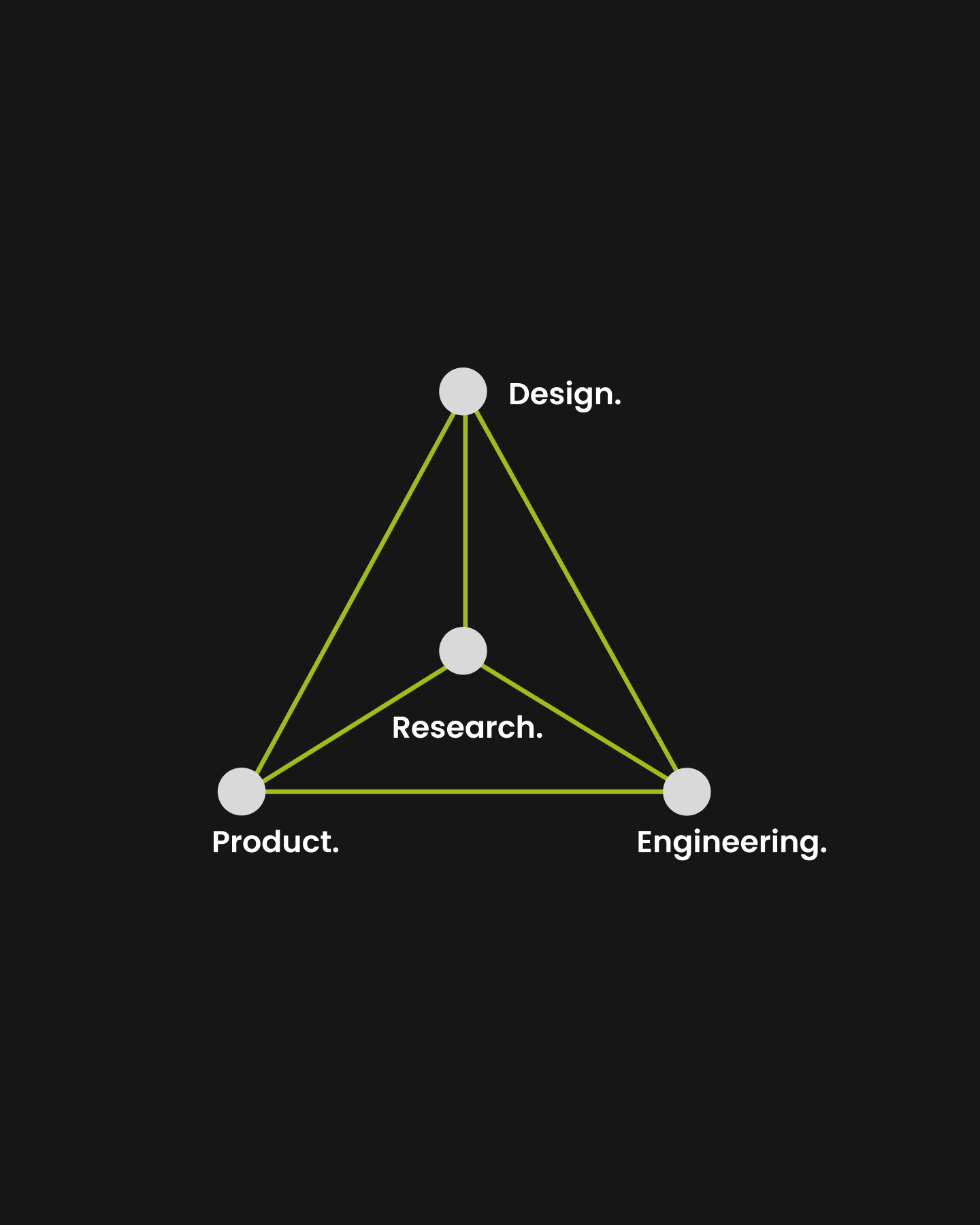
I want to introduce what I’m calling the Tetrahedral Product Organization (TPO) model. It’s a diagnostic framework that borrows from systems theory, specifically the idea that stable systems need interconnected components working together dynamically.
The interesting part isn’t the four “nodes”—it’s the six relationships between them.
Those critical flows of information, communication, and collaboration that either make or break organizational effectiveness. By looking through this lens, leaders might be able to move beyond those static departmental silos. Instead, they could intentionally design a dynamic system that actually anticipates conflict, builds shared purpose, and creates the kind of deep relationships that produce breakthrough products.
Where Does This Come From?
The tetrahedral model from systems thinking theory provides a useful framework for understanding core relationships within organizations. Buckminster Fuller identified the tetrahedron as the simplest stable system—the most basic three-dimensional form that can enclose space while maintaining structural integrity.
Rather than viewing departments as isolated units, this approach examines what’s happening in the coordination between them.
Fuller’s insight was that any stable system requires at least four interconnected points to define both an “inside” and “outside.” This creates the boundary conditions necessary for a system to hold together internally while staying responsive to its environment.
The tetrahedral model identifies four components in complex systems:
Nodes represent stable organizational elements that change slowly and resist external pressures. In product organizations, these correspond to the four core disciplines—each with distinct methods, success metrics, and professional cultures that evolve gradually over time.
Synergies describe the dynamic interactions between nodes. These relationships change rapidly in response to communication patterns, shared processes, and collaborative practices. Unlike nodes, synergies can potentially be redesigned relatively quickly through operational changes.
Fields emerge from triangulated relationships between three nodes, creating novel areas of inquiry that wouldn’t exist within any single discipline.
The Void represents accumulated organizational knowledge and intuitive decision-making capability that develops when the other three elements function effectively together.
This echoes other frameworks, such as the Tetrahedral Model of Performance (T-MoP), which examines how individual, team, and organizational capacities interact with cultural foundations.
The Six Synergies That Make or Break Teams
When applied to product teams, the four nodes become:
- Product Management: Strategy development, requirement definition, market analysis
- Design: User experience research, interface design, usability testing
- Engineering: Technical architecture, implementation, system performance
- Research: User behavior analysis, market validation, evidence generation
These nodes form your stable foundation—the core competencies that change slowly and resist disruption. But the real action happens when the six synergies that connect them work well.
AB: Product ↔ Design: Strategy and user experience inform each other. Business goals align with user needs. When it doesn’t: Design becomes decorative. Strategy ignores user experience. You end up with feature factories.
AC: Product ↔ Engineering: Technical feasibility shapes strategic decisions. Roadmaps reflect engineering realities. When it doesn’t: Engineering becomes an order-taking function. Technical debt accumulates from unrealistic timelines.
AD: Product ↔ Research: Strategy gets backed by evidence. Market insights drive product decisions. When it doesn’t: Research becomes confirmation bias. Data gets cherry-picked to support predetermined strategies.
BC: Design ↔ Engineering: Technical constraints inspire creative solutions. Implementation enhances design intent. When it doesn’t: You get “Design vs. Engineering” battles. Solutions that look good but perform poorly.
BD: Design ↔ Research: User insights directly inform design decisions. Design solutions get validated with real users. When it doesn’t: Research becomes post-hoc justification. Design based on assumptions rather than evidence.
CD: Engineering ↔ Research: Technical decisions get informed by user behavior data. Performance optimization driven by usage patterns. When it doesn’t: Engineering optimization happens in isolation. Technical metrics disconnected from user impact.
When Things Go Wrong
What worries me about negative synergies is that they are often completely invisible to leadership.
Teams can appear functional—meetings happen, deliverables ship, processes get followed—while destructive patterns slowly eat away at organizational effectiveness. I’ve seen some warning signs that suggest negative synergies:
- Information flows in one direction. Research reports to Product but doesn’t influence Engineering decisions. Design hands off to Engineering, but doesn’t collaborate on implementation.
- Defensive language becomes the norm. You hear “Engineering says it can’t be done” instead of “Let’s explore technical approaches together.”
- Teams work in parallel on related problems without knowing what each other discovered.
- Each group optimizes for different success criteria without understanding how they affect each other.
- Disagreements get resolved by hierarchy rather than evidence or collaboration.
The combination of these patterns produces predictable dysfunction. Strategy development occurs without user experience input, resulting in features that meet business goals but create usability nightmares. Or design work proceeds without a strategic context, producing interfaces that satisfy users but don’t support business objectives. Meanwhile, technical decisions get made without behavioral data about how users actually interact with systems. Performance optimization happens independently of usage patterns. Research insights don’t inform architectural choices. Then, design specifications don’t account for implementation constraints. Engineering solutions compromise user experience without design input. Quality emerges from negotiation rather than collaboration.
Building Better Connections
Transforming negative synergies isn’t about restructuring your org chart. It’s about designing systems and practices that encourage productive connections between nodes.
1. Design Information Architecture, Not Just Org Charts: Map how insights actually flow between your four nodes. Where does user research land? How do technical constraints get communicated to Product? When does Design learn about implementation challenges?
Great product organizations seem to be great information architectures.
2. Create Shared Success Metrics: Each node should have success metrics that depend on other nodes. Product success might include user satisfaction metrics owned by Design and Research. Engineering success could include user performance metrics. Design success might include technical implementation quality.
3. Establish Cross-Node Rituals: Weekly syncs aren’t enough. Create recurring practices that require multiple nodes to contribute: Design and Engineering pairing sessions, Product and Research strategy reviews, Research and Engineering data deep-dives.
4. Rotate Perspectives: Temporarily embed people in different nodes. Let Product Managers shadow user research sessions. Have Engineers participate in design reviews. Give Designers access to product analytics.
5. Make Negative Synergies Visible: Create mechanisms to surface when negative patterns are emerging. Regular retrospectives focused specifically on cross-node collaboration. Anonymous feedback systems for identifying information bottlenecks.
The Fields: Where New Things Emerge
When you optimize the synergies between your four nodes, new fields of inquiry emerge from their triangulated relationships.
Product-Design-Engineering triangulation reveals new technical approaches to user problems. Design-Research-Engineering triangulation uncovers implementation opportunities that traditional user research wouldn’t catch. Product-Research-Engineering identifies market opportunities that require technical innovation.
These fields represent your organization’s innovation potential—the novel areas of exploration that emerge when your disciplines work in harmony rather than isolation.
A Practical Starting Point: The Synergy Audit
If you want to start building a tetrahedral product organization, begin with a synergy audit:
Map current information flows: How does information currently move between Product, Design, Engineering, and Research?
Identify negative patterns: Where do you see defensive language, escalated conflicts, or misaligned metrics?
Design positive interventions: What specific practices could improve the weakest synergies?
Create feedback loops: How will you know if your interventions are working?
Iterate and strengthen: Which positive synergies can you amplify? Which negative ones need continued attention?
Beyond Process: The Mindset Shift
The tetrahedral model suggests that exceptional product organizations are systems designed to amplify the connections between disciplines.
This requires a fundamental mindset shift from optimizing individual nodes to optimizing the synergies between them.
From hiring the best Product Manager to creating the conditions where Product, Design, Engineering, and Research can do their best work together.
The geometry matters. When you think in tetrahedra rather than silos, you start to see opportunities for connection and collaboration that traditional organizational thinking misses entirely.
The most successful product organizations of the next decade probably won’t be those with the strongest individual disciplines. They’ll likely be those who master the art and science of positive synergies in the spaces between Product, Design, Engineering, and Research, which is where breakthrough products are really born.
Want to assess your current synergies? Start by mapping one week of cross-node interactions. Where do you see collaboration? Where do you see isolation? The patterns will show you exactly where to begin.
