
The Scalar Leadership Framework
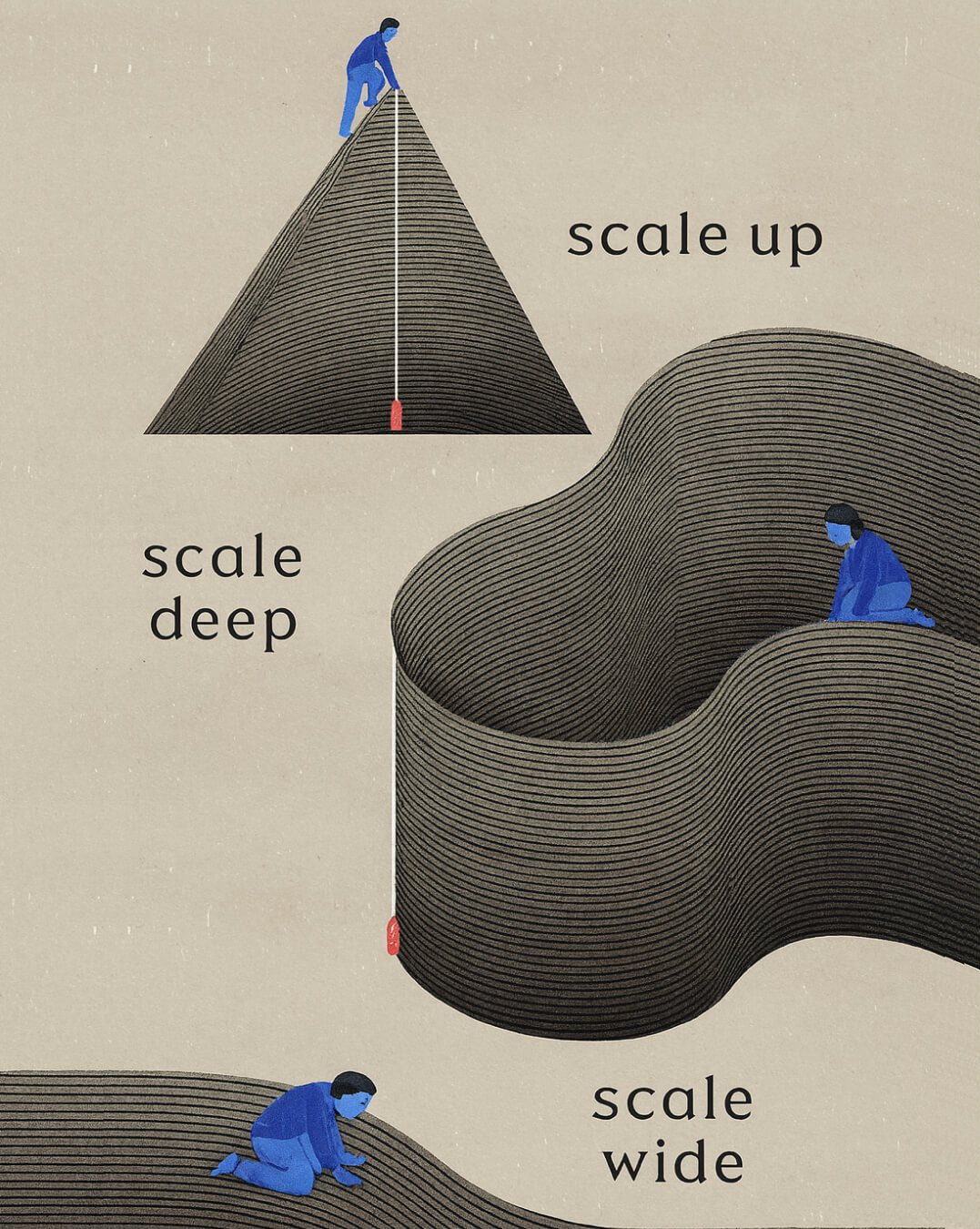
Scalar leadership is a framework that builds resonant relationships through high-quality interactions with team members across the organization. It serves as both a management tool and a leadership strategy for design leaders, developed through six years of research in creating diagnostic tools for leading design teams. The framework operates at three levels of scale:
Scale Deep: People as interconnected systems. This level transforms cultural impact, enhances team cohesion, and fosters self-empowerment.
Scale Wide: Problems as transdisciplinary challenges. This level prioritizes horizontal cross-domain integration, expanding design impact across cross-functional teams to solve business problems.
Scale Up: Organizations as designable systems. This level prioritizes vertical hierarchical cascades that influence leaders and policies through design.
These three levels are analyzed across five organizational dimensions: personal (individual capacity), team (direct relationships), strategy (business context), product (outputs and experiences), and organization (systemic structures).
The scalar framework focuses on designing conditions that promote collective excellence—from personal growth and team collaboration to strategic design differentiation, product consistency, and organizational design maturity.
My Commitments to Design Excellence
Over the years, I've learned that leading teams isn't about having all the answers; it's about creating relationships and conditions that enable others to do their best work. I've developed five core commitments that I make, which have helped my teams remain resilient to change, especially in a VUCA world (Volatility, Uncertainty, Complexity, and Ambiguity) — a framework that describes unpredictable business conditions. These five commitments guide how I build resilient, high-performing design teams in rapidly changing environments demanding speed and agility. These commitments are made through my five organizational scales, as outlined in the scalar framework.
Personal: I commit to prioritizing each team member's well-being and sustainable growth.
Product: I commit to elevating design craft as a strategic differentiator.
Team: I commit to building autonomous, collaborative, and continuously learning teams.
Strategy: I commit to positioning design as a driver of product strategy and future vision.
Organization: I commit to building design's influence and value across the entire organization.
These commitments create conditions where collective design excellence emerges naturally, shifting focus from "How can I become a better leader?" to "How can I create conditions where leadership emerges within interconnected systems?". Learn More

My Ask
ExploreMy 5 Asks for Design Teams
After years of leading design teams, I've learned that people expect clarity from their leaders about how their work connects to larger goals, while also feeling supported enough to embrace creative discomfort in high-pressure environments. These five asks build trust and eliminate ambiguity in complex organizations.
1. Own Your Working Style and Growth: I ask you to help me understand how you work best so I can position you for success.
2. Understand Your Design's Full Impact: I ask you to take responsibility for both your internal growth and the external impact of your design decisions.
3. Balance Deep Work with Strategic Collaboration: I ask you to protect time for both craft excellence and meaningful team engagement.
4. Connect Your Work to Organizational Strategy: I ask you to actively understand and articulate how your contributions shape company direction.
5. Build Cross-Functional Partnership: I ask you to position design as a valuable collaborator, not just a service provider.
These asks create conditions for teams committed to great design work to achieve design excellence through individual and collective impact. Learn more
Speaking + Presentations
ExploreSpeaking + Presentations
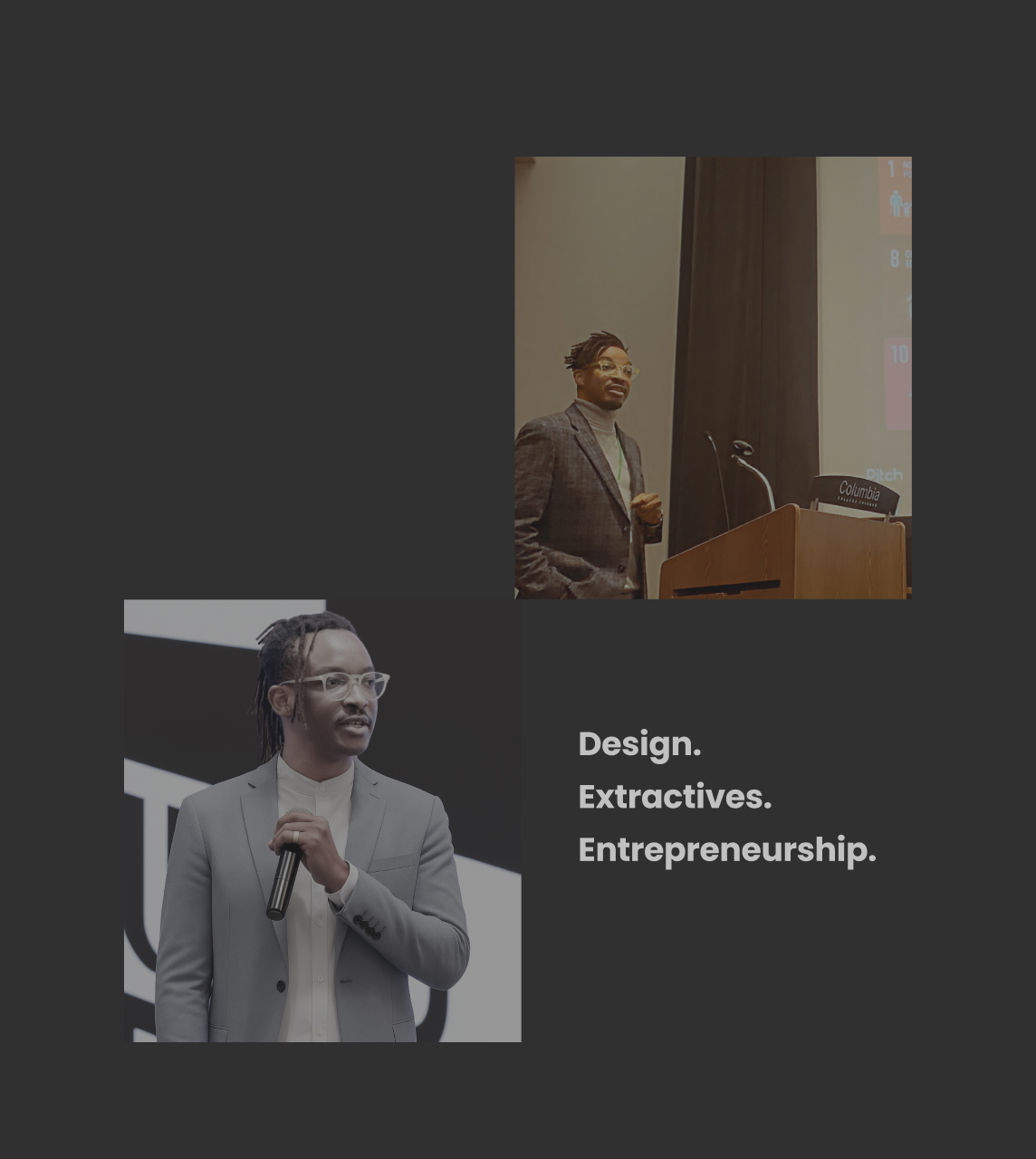
I speak and write on various topics such as the future of strategic design, product design, AI & AR/VR futures, and design management. I also speak on the future of mineral resource systems and their impact on the African continent and have delivered numerous talks and workshops at conferences and organizational forums in both private and public sectors. Let's work together, get in touch. Below are some recent engagements:
- Sustainable Jewelry: Artisanal Diamond Mining in Sierra Leone as a Means for Change
Living Room sessions // 2024 - Current Practice and Future of Strategic Design
Parsons School of Design Alumni Panel Series // 2024 - African Mineral Resources: Its Promises and Current
The Nordic Africa Institute // 2024 - Technology, Humanity, and Social Justice
University of Pittsburgh // 2023 - Leading Through a System Design Lens
MIT // 2023 - Sustainability and Design Alumni Engagement
Parsons School of Design // Celebrate Parsons // 2023 - Innovations in Design Leadership
UCLA // 2023 - The current State of Artisanal and Small Scale Diamond Mining
Chicago Jewelry Conference // 2022 - The Future of Design Education
University of Utah // 2022
Mentoring and Consulting
ExploreMentoring and Consulting
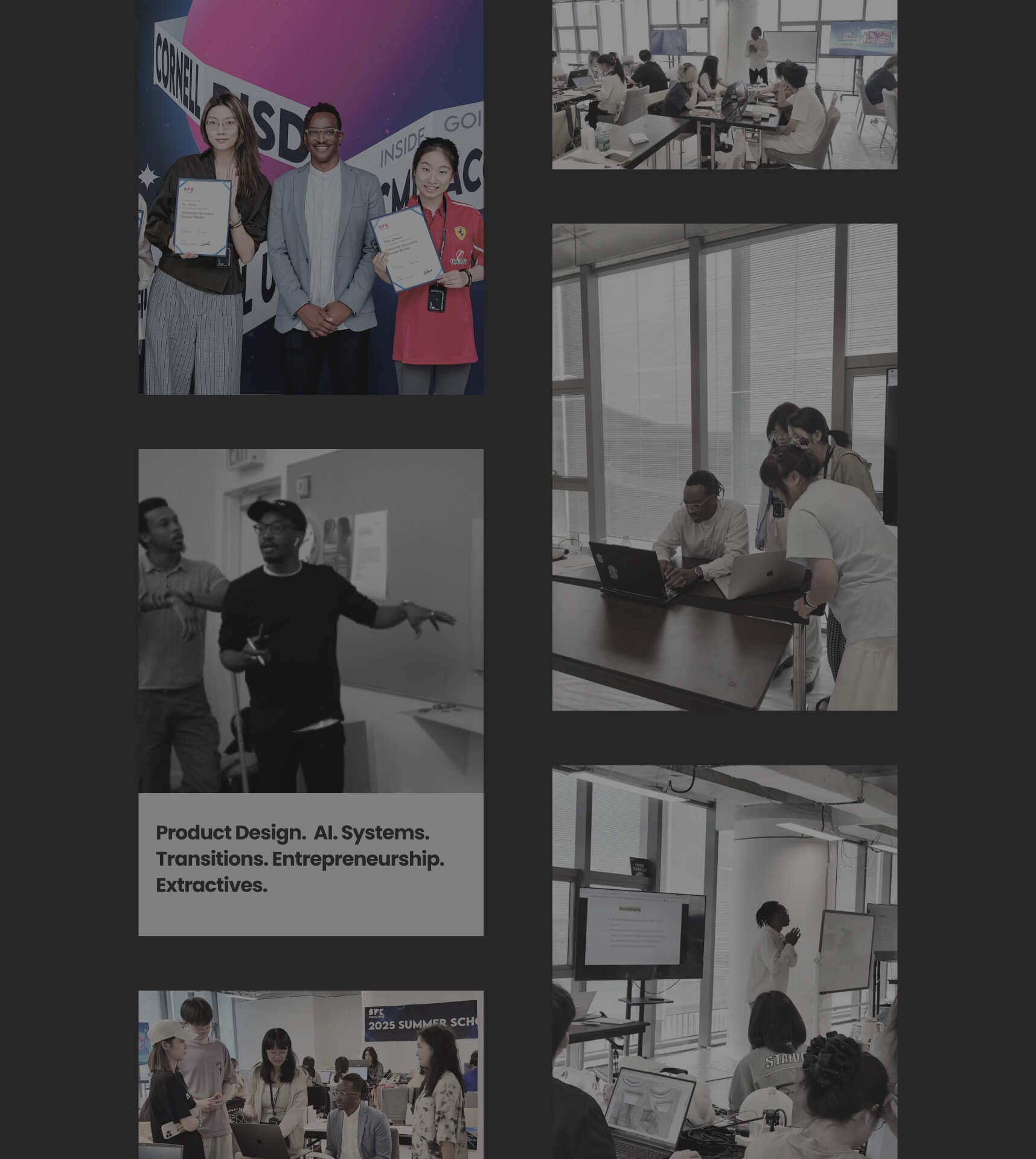
My work integrates design strategy, applied research, and education to build products and support long-term system change. I consult and collaborate on:
- Product Design, Design Ops, and Design Leadership
- Designing Sustainably AI Products and Services
- Systems Thinking and Digital Research Platforms
- Post-extractive Frameworks and Sustainable Transitions
- Entrepreneurship, Design-led Innovation for Civic, Infrastructure, and Policy Contexts
- Academic-Practitioner Partnerships and Curriculum Strategy
I offer consulting services to organizations in my areas of expertise. I also provide free coaching and mentorship to individuals from underrepresented communities in design, research, business, the extractive sector, and technology. To discuss consulting or mentorship opportunities, get in touch.

Meta
Explore
Team & Leadership Responsibilities
As Design Manager for Meta's Enterprise Infrastructure, Security, & Analytics (EISA) division, I led initiatives to enhance the team’s design footprint and processes through strategic leadership. By focusing on team restructuring, product deployment, and innovative design programs, I improved the team's maturity from Level 1 (basic producers) to Level 3 (strategic architects), repositioning Design from a tactical service provider to a strategic business partner.
Confidentiality: Due to the sensitive nature of Meta's corporate infrastructure and security organization, certain metrics and product development details have been adapted while preserving key skills and impacts.

Leadership Initiatives
I implemented strategic programs across 14 different product portfolios through a scalar leadership approach—scaling up, wide, and deep. This comprehensive strategy transformed how engineering and product teams address design challenges and increased team capacity through structured evaluation and growth frameworks.
Design Programs & Actions
Design Excellence & Operations
As a team lead, I revolutionized design infrastructure through multiple key programs. The Design Hub became our centralized collaboration platform, standardizing practices across all product portfolios, and a comprehensive Design Handbook established clear design practices and strategic direction. My team’s UX Tooling Strategy integrated Figma, Mural, and Lucidchart, significantly reducing documentation time. We implemented AI-driven interventions to improve compliance and design system adoption while creating new design service offerings to support our growing product portfolios.
Research & Innovation
I transformed the team’s research capabilities through three major initiatives. The Minimum Viable Research (MVR) Model streamlined research processes and established clear deliverables for product development. Our Enterprise AI Research Platform reduced documentation time and accelerated self-service design support by 45% across 30 teams. The Design Metrics Framework implemented product-led growth measures to track user engagement and product adoption across all portfolios, providing actionable data for improvements.
Team Development & Culture
One of my key leadership goals was to improve the team culture. Through my leadership, the team culture evolved through structured programs providing access to belonging initiatives, growth opportunities, and resources. The Design Muscle Program delivered weekly educational sessions to elevate team maturity in craft, theory, and industry innovations. We implemented the Design Pulse Framework for monthly feedback and accountability. Our Career Development Matrix created comprehensive growth paths across 14 dimensions, ensuring clear professional development opportunities for every team member.
Cross-Functional Integration
I practiced the Scalar Leadership Approach extensively, and it helped enhance team cohesion and cross-functional collaboration. This framework helped build engineering trust by enhancing relationships through our engineering-design Sync Model. I also applied the Transition Design Framework, a spillover from my Ph.D. research that helped implement design changes across the organization while ensuring alignment with business objectives and stakeholder needs.

Leadership Impact
Scale Deep (Short-Term Impact)
My short-term impact in leading the design team saw us optimize processes, improved design workflows, and reduced documentation time. These operational enhancements built trust and cohesion in the team, creating foundations for effective collaboration and transparent communication. The changes also helped me build credibility so I could become a leader my team trusted, which increased acceptance of my ideas.
Scale Wide (Mid-Term Impact)
My small success with my immediate design teams made my designers a key advocate for my initiatives, which in turn allowed my team to build credibility with other team members, such as product managers and designers. This advocacy allowed me to establish trust with cross-disciplinary teams and improved visibility, especially with engineering managers who control the yearly budgets on which my designers depend. My monthly meetings with engineering managers helped me to build relationships with most of them, and I became a key point of contact for product design. Most importantly, the design team achieved active participation in roadmap planning, where research and design now influence product strategy during H1 and H2 planning.
Scale Up (Long-Term Impact)
My leadership strategy improved the design team, who, at the time of my arrival, were siloed designers working in different teams within Meta. My leadership helped advance the design team from Level 1 to Level 3, ultimately transforming design's role within Meta's EISA division. We expanded design's influence among non-designers and reinforced design-driven projects with greater purpose, establishing design as a key strategic asset integrated with engineering, product management, and project management.
Carnegie Mellon University
Explore
Team & Leadership Responsibilities
As a Design Advisor at MIT GOV/LAB, I partnered with researchers and practitioners in African governments, primarily Sierra Leone and Nigeria. My work centered on implementing the Lean Governance Innovation Design (LGID) framework to bridge the trust gap between governments and their citizens. Many citizens in our partner countries believed their governments were intentionally misleading them. This deep-rooted mistrust cannot be addressed through traditional Western solutions; it requires an approach that integrates local values and practices. Working alongside service designers and researchers, we took a place-based approach that honored local cultural practices rather than imposing external solutions. I used research and strategic interventions to strengthen government-citizen relations while respecting and working within existing cultural frameworks.
Confidentiality: I've adapted specific details to protect our partners' privacy while maintaining the integrity of the key skills and impacts.
Leadership Initiatives
My work focused on developing research methods and strategies that integrated the Transition Design approach with LGID. These strategies center local cultural practices through human-centered design principles. This transdisciplinary approach strives to develop adaptive solutions in the complex public sector through research and engagement.
Design Programs & Actions
Research & Innovation
Our research journey began with developing and refining the LGID framework, which blends human-centered design with local governance practices. We created a standardized approach that made our insights accessible and actionable across different government agencies. This process helped us move beyond traditional bureaucracies by gaining support across multiple sectors.
Stakeholder Engagement
We ran hands-on workshops that created direct dialogue between government officials, civil society representatives, and citizens. These sessions, both online and in-person, became crucial spaces for co-creation and built trust between stakeholders. We extended our reach by building partnerships with NGOs, academic institutions, and government agencies across Nigeria, Sierra Leone, Mexico, Brazil, Cape Verde, and Kenya, creating a network of change-makers committed to improving governance.
Capacity Building
Instead of providing solutions, we focused on enabling local teams to drive innovation. We developed LGID training modules that helped practitioners implement these principles in specific contexts. The program emphasized knowledge sharing and mutual learning. We also helped government leaders understand how to leverage appropriate technology for improved governance, ensuring all solutions aligned with local infrastructure and capabilities.

Leadership Impact
Short-Term Impact
The early lessons from our engagement have helped us understand how best to embed designers within a local context. The failures and successes have also helped us better understand that a designer must have a grounded, place-based mindset for interventions to work. Within the first year, we built foundational resources that people who wanted to positively affect the government could immediately use. Most importantly, we created an active community of practice where governance innovators actively share challenges and opportunities.
Mid-Term Impact
The documentation of learning case studies is building a repository of our methodology beyond initial partner countries. The goal is to improve and reshape how design thinking applies to governance challenges in emerging economies. The MIT GOV/LAB platform has enabled sustainable knowledge-sharing processes, reaching practitioners across multiple continents. This growing network of governance innovators is actively sharing insights and adapting methodologies to their local contexts.
Our vision is to establish LGID as a recognized methodology in governance innovation, moving away from traditional intervention models. We're developing replicable frameworks that help governments develop locally appropriate approaches for citizen engagement that can be adapted to different cultural contexts, increasing the probability of locally driven innovation.
Consumer Reports
Explore
Team & Leadership Responsibilities
I spent a year working with Consumer Reports as the research director on a consultancy basis with a focus on accelerating digital ventures in financial advice and home maintenance. During this time, Consumer Reports needed to expand its digital offerings while maintaining its gold standard for consumer-focused research. This meant transforming traditional research approaches into agile, data-driven processes without compromising the thorough, reliable consumer research that built the company’s reputation. I led research initiatives and supported six research and design teams, which operated through a matrix structure, embedding research units within product teams while maintaining centralized standards. By implementing standardized methodologies and automated frameworks, I helped the broader research and design teams transform product development. This work successfully accelerated the launches of Upkept and CRInvest.
Confidentiality: To protect proprietary information, certain metrics and product development details have been adapted while preserving key skills and impacts.
Leadership Initiatives
My goal in the year was to accelerate Consumer Reports' research capabilities.
Design Programs & Actions
Research Excellence & Operations
After creating a robust data infrastructure to conduct and house research data, my focus was to help build automated analysis frameworks. I implemented standardized methodologies across product teams and a centralized research participant management platform that improved data accuracy and accessibility. These improvements streamlined our research-to-design pipeline, allowing product teams to generate insights faster.
Digital Venture Research & Innovation
The research initiatives accelerated the ongoing innovation-viable product research, leading to the development of two new products under the Consumer Report brand. The first product, Upkept, is a home maintenance platform. My leadership helped deliver an analysis of user needs and a series of market validation studies, equipping the research team with practical methods and frameworks. With the other product, CRInvest, I guided end-to-end user research for the financial advice tool, ensuring a strong product-market fit. My work in developing a systematic approach to competitive analysis and market positioning for this product became adopted as a standard that supported strategic decision-making across new ventures.
Team Development & Process Optimization
My processes helped to build unified research approaches across six research and design teams for consistent outputs. I used regular sharing sessions and methodology workshops to keep all units aligned, creating a culture of continuous learning and improvement across the organization.
Leadership Impact
Short-Term Impact
In the year I was at Consumer Reports, I implemented an automated research analysis framework and data infrastructure repository that immediately reduced research overhead time. Teams saw significant improvements in data accuracy and accessibility, transforming how quickly we could move from research insights to design decisions. The standardization of methodologies across six research teams created consistency and efficiency in our work – while significantly reducing research-to-design cycles.
PTC
Explore
Team & Leadership Responsibilities
As a senior product designer at PTC, I led the user experience strategy for AR/AI products serving over 1 million enterprise users, focusing on remote assistance and work instruction tools. I drove the transformation of industrial AR applications through comprehensive field research and AI integration, collaborating directly with manufacturing partners across 40 industrial locations. Under my leadership, I implemented three core methodologies: field-based user research, iterative AR prototyping, and AI-enhanced user testing. This approach included establishing regular on-site observations, rapid prototyping sessions, and continuous feedback loops with manufacturing teams, ensuring solutions met real-world industrial needs.
Confidentiality: Given the sensitive nature of industrial AR/AI implementations, certain technical specifications and client details have been adapted, while accurately representing the impact of our manufacturing solutions.
Leadership Initiatives
As Senior Product Designer at PTC, I led the user experience strategy for AR/AI products serving over 1 million enterprise users. Through implementing three core methodologies—field-based user research, iterative AR prototyping, and AI-enhanced user testing—I drove the transformation of industrial AR applications while collaborating directly with manufacturing partners across 40 industrial locations.
Design Programs & Actions
Cross-Platform AR Experience & Operations
Vuforia Chalk Development: Led the creation of an intuitive remote assistance interface used by 1M+ enterprise users daily, establishing new standards for industrial AR applications.
Platform Integration Framework: Developed unified experience architecture across web, mobile, and RealWear AR interfaces, ensuring consistent user experience across all platforms.
Design System Standards: Created comprehensive AR interface guidelines and standardized design patterns for industrial AR applications, accelerating development cycles while maintaining consistency.
AI-Enhanced Manufacturing Solutions
Expert Capture Tool: Developed AI-guided UX systems that significantly reduced training time and improved operational accuracy across manufacturing operations.
Real-time Object Detection (RTOD): Created MVP with enhanced AI recognition capabilities that reduced spare parts order errors in the $2B industry.
Manufacturing Intelligence Framework: Implemented AI-driven analytics to optimize workflow patterns and improve operational efficiency.
Field Research & Implementation
Manufacturing Site Studies: Conducted comprehensive research across 40 industrial locations, documenting and analyzing industrial workflow patterns.
User Behavior Analysis: Established a systematic approach to capturing and analyzing industrial workflow patterns, creating actionable insights for product development.
Feedback Integration System: Created continuous improvement cycle with end-users, ensuring product evolution aligned with actual manufacturing needs.

Leadership Impact
Short-Term Impact
Implemented initial cross-platform AR interface for Vuforia Chalk, establishing immediate improvements in remote assistance capabilities. Achieved early adoption among manufacturing teams and demonstrated potential for scaling across industrial sites.
Mid-Term Impact
Developed and deployed AI-enhanced features through Expert Capture Tool, resulting in significant reduction in training time and improvement in operational accuracy. Expanded implementation across 40 industrial sites while refining the user experience based on field feedback.
Long Term Impact
Created lasting transformation in industrial manufacturing processes through AR/AI integration, establishing new standards for remote assistance and work instruction. The implemented frameworks continue to drive innovation in industrial AR applications, supporting PTC’s position as a leader in manufacturing technology.
My systematic approach to industrial AR/AI design transformed PTC’s impact in the manufacturing sector. Through comprehensive field research and user-centered design methodologies, we successfully developed and implemented AI-guided UX solutions that delivered measurable improvements in efficiency and accuracy. The success of Vuforia Chalk and Expert Capture Tool demonstrated the effectiveness of our integrated approach to AR/AI innovation. These initiatives helped reposition PTC’s design function from traditional UI development to strategic AR/AI experience innovation, directly contributing to PTC’s goal of revolutionizing industrial manufacturing through advanced technologies. The transformation has established new standards for industrial AR applications while delivering substantial business impact in the $2B industry through improved efficiency and reduced errors.
Leadership Philosophy
Leadership Case Studies
METAGroup Design Manager
MIT GOV/ LabDesign Advisor and Government Innovation
Consumer ReportsResearch Director
PTCSenior Product Designer