
Design · 9 min read
Extractive 2.0: The Enduring Logic of the Extractive Empire
A Systems Model for Cross-Disciplinary Coordination
Extractivism is a planetary cancer.
The illusion of progress is often sold as modernity by the Global North to the Global South. The drive for scale during the Industrial Revolution transitioned into the rise of technological commerce, which continues to propel transnational corporations toward what I call extractive obesity – extractive overshoot practices that excessively exploit resources and labor from mining communities. This unfettered extraction of resources relies upon the destabilization of communities in African regions rich in mineral resources. These communities become “sacrifice zones” and “sacrifice bodies”. Surviving within the global economic system in the name of progress requires ecological and social compromise from our leaders, often leaving these communities with the existential threat of self-termination.
Today, as artificial intelligence companies build what Karen Hao calls the “Empire of AI,” the same colonial patterns are being replicated globally through data extraction. This new form of extraction exploits vulnerable workers while concentrating power among a small group of Silicon Valley elites.
The journey from physical to digital extraction is not a radical break from the past; it is a direct continuation of the same economic and social logic.
The Anatomy of Physical Extraction
Any meaningful analysis of our device society must begin with the physical realities that define it. The historical and contemporary practice of mineral extraction in the Global South provides a powerful and tragic entry point into this discussion.
Extractive capitalism in the Global South and the sharing of African resources without Africans’ consent began with the Berlin Congo Conference of 1884. Formal colonialism has ended, but colonial perceptions of Africa remain, and a neocolonial fractal supply chain of exploitation of resources and labor continues to gut Africa of its mineral wealth for the production of finished products. Rock-bottom prices force artisanal miners to expand their mines. Where maximized extraction is the only way to survive, disasters plague communities. The 2020 Kamatuga mine collapse, which killed 50 Congolese miners, was one of the worst in memory. The pattern of exploiting the world’s poorest to create wealth extends to AI development, where Scale AI and Sama have utilized Venezuela’s economic collapse and the pandemic’s economic impact in Kenya to force workers into psychologically damaging tasks in exchange for abysmally low wages. Hao traces Kenyan workers receiving $2 an hour to filter toxic content for OpenAI, including child sexual abuse material.
This extractive legacy is further compounded by a reverse flow of materials. While resources are extracted from Africa, the continent also serves as a dumping ground for the Global North, particularly electronic waste. Each year, around 150,000 tonnes of e-waste are shipped to Ghana, a country that lacks the capacity to recycle all the hazardous materials it receives. Minerals mined in Africa, such as cobalt, coltan, and lithium, are foundational components for the digital devices that, at the end of their lifecycle, become e-waste in Ghana. Yet, processing e-waste provides a source of income for a country where 27% of the population lives in poverty.
The Insidious Logic of Digital Extractivism
My “diamond mines to data mines” thesis gains its full power when the historical precedents of physical extraction are applied to the contemporary AI industry. The concept of extractivism is rooted in a colonial mindset that views resources as something to be taken for accumulation, without regard for the relationships that give them meaning.
This same logic is the foundation of digital extractivism: harvesting user data.
This new form of extraction mirrors its historical predecessor in its core components. Data is acquired on a pervasive scale from devices, processed to extract economic value, and the benefit is captured disproportionately by a few powerful entities. This parallel extends powerfully to human labor. Just as physical mines rely on the exploitation of low-wage workers, the AI industry is built on a similar foundation of outsourced labor.
Reports from former workers in Kenya indicate they were paid as little as $2 per hour to filter disturbing content for companies like OpenAI, a fraction of what their counterparts in developed nations earn for the same work. This work is emotionally draining and psychologically traumatic.
The minds and mental health of these moderators are treated as a resource to be consumed, creating a mental sacrifice zone where their psychological well-being is commodified and sacrificed for the functioning of digital platforms.
This is a subtle yet profound form of violence that is a direct outcome of the extractive logic.
Another crucial element of this model is the illusion of user consent. Hundreds of millions of people voluntarily use tools like ChatGPT, yet there is inherent coercion in modern digital life. Consent on digital platforms is often an illusion to legitimize data extraction. In a world where digital participation is necessary for economic and social engagement, a person’s choice to use a platform is not truly free. This is a modern parallel to the coerced choices faced by artisanal miners who must risk their lives for a chance at economic survival.
A Comparative Analysis of Extractive Empires
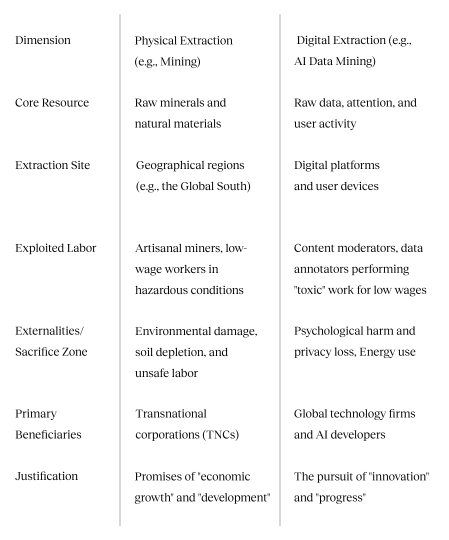
A systematic comparison of physical and digital extraction is invaluable. The following table provides a clear reference that moves the discussion from abstract metaphor to concrete, evidence-based parallels.
Data and labor integrated
Extractive capitalism shows no signs of disappearing because our lives have been choreographed around technology consumption.
Alongside minerals, our data has become a fundamental resource for tech firms that aim to extract it as rapidly as possible. AI companies operate as “empires” that seize and extract valuable resources, including the work of artists, writers, and online users.
Where physical resource extraction has origins in the Berlin Congo Conference, the extraction of data from users in the global north originates from the original tech boom in the millennium. Known as the “dot-com frenzy” and the “Golden Spike,” the “information superhighway” began, allowing unprecedented quantities of data to be processed. Soon, data became a source of profit that could be sold to advertisers or leveraged to improve services. This led to an infinite form of extraction that has dehumanized our interactions with devices.
Tech firms treat users as operators in the data production chain.
The devices we use every day are “disembodied listening agents”, listening to every word we say and using them to improve the algorithms in a constantly developing device.
As seen from the extraction of natural resources in the Global South, depersonalization of those in sacrifice zones is required to justify extraction. Doing so is simple from the perspective of the Global North, as by outsourcing sacrifice zones to communities we are racially prejudiced against, we do not have to confront them in our daily lives. Depersonalization is more complex for data extraction because it affects all of us. The key that has depersonalized our interaction with devices is the treatment of us as “operators”, not recipients of digital products, with our sole value being to produce data that “product as a service” industries can sell. OpenAI’s leadership views this process through the lens of colonial expansion, using ideas like “civilizing missions” to legitimize their actions, while ensuring that the benefits remain within the Silicon Valley elite.
As with all forms of extraction, data extraction needs laborers. Tech companies aim to work us as hard as possible. They have designed their products to encourage us to use them for as long as possible. The clearest example is the increasing shortening of media as practiced by TikTok and others maximizes dopamine production in the user, leading to addiction and shortened attention span. This addiction has made data extraction a sacrifice zone in its own right, with investigations revealing that excessive TikTok use contributes to anxiety and depression in young people.
Reclaiming the Future from Extractive Logic
Thankfully, firms are becoming aware of the perils of uncontrolled natural resource extraction on a planetary and individual basis. Some firms in the diamond industry are developing profit-sharing models to improve the welfare of mining communities. Lucara Diamonds works closely with local communities, keeping mines open only as long as needed and reinvesting profits into projects that tackle food scarcity.
Closer to home, Affectiva has leveraged deep learning to build the world’s largest database of human emotions. It holds ten million facial expressions from 87 nationalities. Initially used by advertisers, the database is now being utilized more ethically in the automotive and education industries to detect when a user is losing concentration.
Global resistance movements have also emerged to lead alternative approaches to AI development. Te Hiku Media in New Zealand has developed AI speech recognition while ensuring data sovereignty and consent are maintained. By using small, task-specific models, two graphics processing units are used rather than the thousands employed by Silicon Valley giants. Similarly, organizations like DAIR (Distributed AI Research Institute) conduct AI research centered on affected communities, while ensuring all labor is fairly compensated.
These organizations have reframed natural resources, both human data and natural, as community-owned assets, used for the benefit of the people. As Hao argues, “Artificial intelligence doesn’t have to be what it is today,” and these examples prove that finding patterns that provoke responsible behavior from both traditional and digital extraction businesses is not only possible but actively emerging worldwide.
The future is not in the end of extraction but in delivering sustainable resource utilization solutions that reduce the prevalence of the exploitative capitalist systems that have led to ecological collapse.
As “Empire of AI” demonstrates, even within the current system, alternative approaches exist that prioritize “human well-being” and “environmental sustainability” over pure profit maximization, suggesting transformation is possible without complete systemic collapse.
Extractivism manifests differently in every context. However, whether it is a Sierra Leonean “half shovel” child miner in the global south, a Kenyan content moderator traumatized by filtering AI training data for $2 an hour, or the average American TikTok user who opens the app eight times a day, extractivism is always labor-intensive and prone to creating sacrifice zones.
Extractivist systems are driven to maximize profits from the earth by unlinking the wellbeing of ourselves and the planet. Human and planetary health are intrinsically tied, and the situation has brought forth an oncoming collapse of both. As Karen Hao’s investigation reveals, we have entered “a new and ominous age of empire: only a small handful of globally scaled companies can even enter the field of play.” Radically transforming pre-existing systems without destabilizing necessary extraction is a challenge for all as we march through the 21st Century—but the global resistance movements emerging from New Zealand to Chile prove that another future remains possible.
